ToolSura Blog
ArticlesAboutContact
Search

Stay in the loop

Join thousands of developers getting weekly insights into modern web development, AI tools, and productivity.

© 2026 ToolSura Blog
AboutContactPrivacy PolicyTerms of ServiceRSS

    Table of Contents

    Snapshot a run with `-report`Compare runs with `-diff`Update and compare in one passNextSources
    HomeToolsura BlogArticle

    Track indexed-vs-not over time with -report and -diff

    A

    Abhay khant

    Jan 1, 1970 • 2 min read

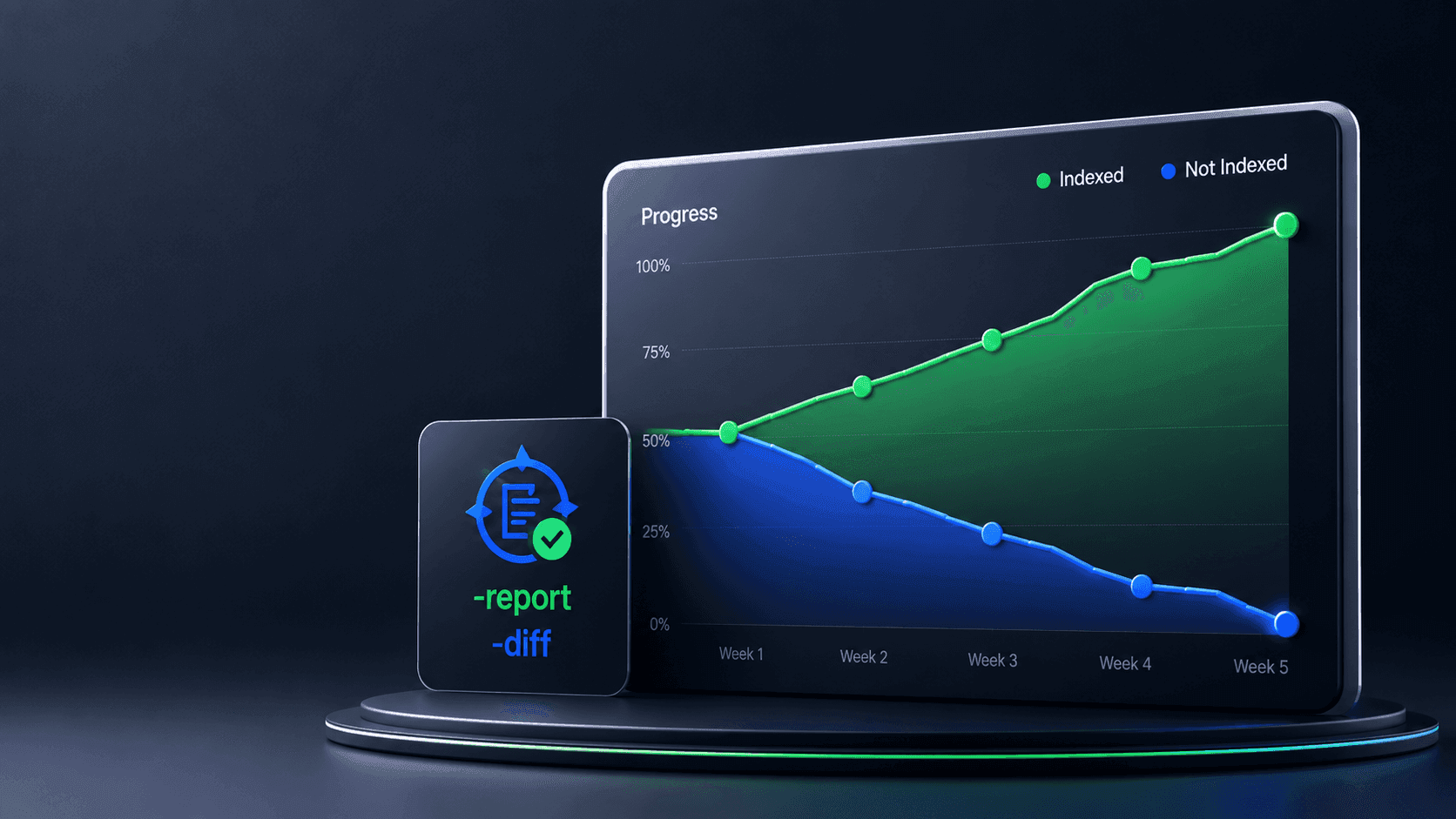
    Want to know whether your pages are actually getting indexed as time goes on? Use -report to snapshot a run and -diff to compare against a previous one.

    Snapshot a run with -report

    -report <dir> writes three files into the directory you name:

    ./gsc-indexer -creds sa.json -batch urls.txt -report ./report
    
    • indexed.txt. URLs Google has indexed.
    • not-indexed.txt. everything else (not indexed, or errored).
    • summary.json. counts + the full URL lists, in machine-readable form.

    The run also prints a summary to your terminal:

    SUMMARY: 87 indexed, 13 not indexed of 100 URLs
      → ./report/indexed.txt
      → ./report/not-indexed.txt
    

    Compare runs with -diff

    Later, re-run and point -diff at the saved summary.json:

    ./gsc-indexer -creds sa.json -batch urls.txt -diff ./report/summary.json
    

    This prints what changed since the baseline:

      ▲ newly indexed:    https://www.toolsura.com/post-new/
      ▼ dropped (was indexed, now not): https://www.toolsura.com/post-stale/
    ...
    DIFF vs ./report/summary.json
      indexed:   87 → 90  (+3)
      not index: 13 → 10  (-3)
      newly indexed: 3 | dropped: 1 | unchanged: 96
    
    • ▲ newly indexed. URLs that moved from not-indexed to indexed.
    • ▼ dropped. URLs that were indexed before but aren't now.

    Update and compare in one pass

    You can write a fresh report and diff against the previous one at the same time:

    ./gsc-indexer -creds sa.json -batch urls.txt -report ./report -diff ./report/summary.json
    

    The diff uses the previous summary.json (read before it's overwritten), so this is safe to run on a schedule.

    Next

    • Large runs timing out? Throttling and quiet mode.
    • Broken run? Troubleshooting.

    Sources

    • Google Search Console
    • URL Inspection API documentation
    • Google Search APIs overview
    • Service account OAuth (Google Identity)
    • About service accounts (Google Cloud IAM)
    • Verify site ownership
    • Property types: URL-prefix vs Domain
    • URL Inspection tool help
    • Indexing API (JobPosting/BroadcastEvent only)
    • Request indexing / inspect a URL

    Frequently Asked Questions

    developer-tools
    cli-tools
    automation
    search
    A

    About Abhay khant

    A passionate tech enthusiast and professional developer specializing in AI, automation, and modern web development. Sharing insights and guides to help others build better software faster.

    View full profile →

    Join the Newsletter

    Get articles like this delivered to your inbox every Thursday.

    What to read next

    Jan 1, 19709 min read

    What Is OpenCode? The 2026 Open-Source AI Coding Agent

    OpenCode topped LogRocket's July 2026 ranking with 160K+ GitHub stars and 7.5M+ monthly devs. A MIT-licensed, model-agnostic AI coding agent.

    AAbhay khant
    Jan 1, 19709 min read

    What Is the Model Context Protocol? A Plain-English Guide

    Model Context Protocol (MCP) is the open standard connecting AI to your tools and data. Learn how it works, how it differs from APIs, and why it matters.

    AAbhay khant
    Jan 1, 197010 min read

    What Are Passkeys? The Passwordless Login Standard Explained

    Passkeys are the passwordless, phishing-resistant login standard replacing passwords. Learn how they work and how they compare to 2FA.

    AAbhay khant